
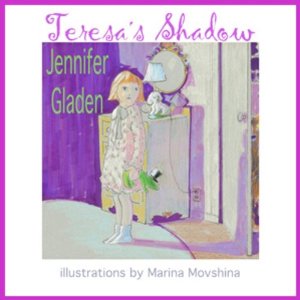
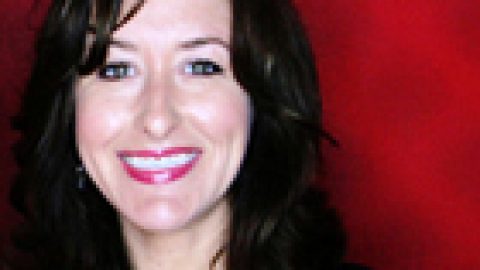
Children’s author Jennifer Gladen is a teacher and mother of three, who lives and writes in Pennsylvania. Her children’s books—A Star in the Night and Teresa’s Shadow—were released by Guardian Angel Publishing last year. Gladen, who also writes stories and articles, launched her own Catholic e-zine: “My Light Magazine.”
Gladen talks about her writing process, offers key advice for those who want to write for children, and more in this Write On! Author Q&A.
Jennifer Gladen and Write On! Online are part of VBT – Writers on the Move. For more writing articles and author interviews, check out the site.
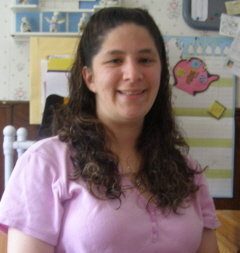
What led you to first start writing?
I’ve always loved writing. I kept journals ever since I could remember. I had a habit of embellishing details if my entries weren’t interesting enough. Once in my high school English class, my teacher wrote on my essay, “Way to go! You little writer, you!” To read that, made me proud of myself at a time when kids find it hard to think well of themselves.
However, it wasn’t until I had my children that I’ve begun to write professionally. I spent some time as a stay-at-home mom due medical problems my two youngest have had. That’s when I dove in, took some courses at the Institute of Children’s Literature, and started writing.
What was your first published piece/book? What inspired you to write it?
My first published piece was a poem for a prolife newspaper titled, “What Could’ve Been.” My faith and values are important to me and I followed what was in my heart. This piece literally wrote itself. … I submitted it to the paper, and they liked it. I saw it in the next issue! That was a wonderful moment for me. I said to myself, “Wow. I really can do this.”
What is your favorite part of being a writer? The greatest challenge?
My favorite thing about being a writer is sharing with the reader. I like sharing stories, information, and values. The greatest challenge is writer’s block. There’s nothing more frustrating than having something to say and not being able to get the words out.
In what ways are writing articles and stories different than/similar to writing a book?
For me, writing a story is like saying to the reader, “Hey, I have something really exciting to tell you.” Where as writing a book is more like saying, “You wouldn’t believe what’s happened to David. Sit down and let me tell you all about it.”
The book is more detailed and you spend more time with the character. A story is a shorter snapshot of a character’s life.
What is your writing process?
I write when the muse hits. I often get story, article and book ideas when driving, walking, working … anywhere but at my desk. So I usually jot down my story idea; sometimes I’ll e-mail myself if I’m away from home. When I am at my desk, I’ll start with revising to get my mind working. Then I move on to my more creative pieces.
What are 3 key elements that should be included when writing a children’s book?
Three main elements to writing a children’s book are:
1. Character Development. A wonderful editor once told me that even with a good story, if readers don’t “feel” your character they won’t care about that character. Avoid the “talking head” syndrome.
2. Add a Twist. Make it interesting. In A Star in the Night, my main character David makes a decision in which he knows is right … but might make mom mad.
3. Include a big finish. End the story well. Your reader should come full circle and feel satisfied at the end.
What are mistakes new authors make?
In addition to writing, teaching and mothering, I am also founder and Editor-in-Chief of My Light Magazine. Some mistakes I’ve observed new writers make are writing in passive voice, having Mom star in the story, and weak endings. But new writers are also very hardworking. Whenever I ask an author to rework the story they are usually eager and thankful for the tips. The result? A better piece of work.
How do you balance being a teacher, author, and Mom?
It’s not easy. When I’m not at work as a teacher, I spend a few hours at my writing desk every night. Saturday is a big writing day for me. But there’s also basketball games, practices, dance classes which I have to get the kids to. The goal for me is to spend a few hours a day devoted to writing. My kids are older now, so they know work time is work time, but they also know I’m here if they need me.
What’s next?
There’s another picture book in the illustration process as we speak. Angel Donor is a specialized book about a young girl in need of a liver transplant. In the story we follow Olivia through the waiting process, the transplant process, and eventually the recovery process.
Additional advice for newbie children’s authors?
Don’t give up. Keep writing. Take advice from other authors, editors and your critique group (yes, these groups are ESSENTIAL). As an editor I must include this: please be professional. If you get a rejection, look over your piece. Send it to the critique group again. See what went wrong. DON’T send insulting e-mails to an editor. Trust me, they will remember. And that’s not the way you want them to remember you.
What do you know now that you wish you knew at the beginning of your career?
Rejections are a part of the writing process.





Comments are closed.
Thanks for hosting me today! It was fun.
Enjoyed your interview. The suggestions for newbie writers are particularly important and most important is, not to quit!
[…] This post was mentioned on Twitter by JenGl, Debra Eckerling. Debra Eckerling said: Q&A with Children's Author Jennifer Gladen, "Teresa's Shadow" http://bit.ly/hOi4jV #writing […]
Great interview. I agree wholeheartedly with the mistakes new writers make. I’ve been writing for years now and I still fall back on those mistakes from time to time. My editor sometimes throw tantrums at certain chapters while others are written really well. 🙂
And yes, never give up, especially if it’s your dream to share the written word with the public.
Good luck!
That was a good tip about avoiding the passive voice, Jennifer – relevant for all writers, but children in particular seem to need the immediacy of active voice. I also like the 3 tips. The best childrens’ lit always has a childs’ perspective. Thanks for sharing with us!
Yes – “Never Quit” should be at the top of the list. Thanks for checking out the post.
Great interview. It’s got to be difficult working, having to care for 3 children, and trying to write. Also, wonderful writing advice: persevere and rejections are part of the process.
Great to get to know you a bit better, Jennifer!
I love your statement “My faith and values are important to me and I followed what was in my heart”
I think more people should feel that way and be led that way.
Great interview.
Good luck
Martha Swirzinski
Thanks for your comments, everyone!
And thanks, Jennifer, for sharing your knowledge and experience with the Write On! Community!
Wonderful interview of Jennifer. I’ve enjoyed getting to know her even better. Women definitely have the knack of juggling all the balls we keep in the air.
Best wishes for your continued success,
Donna
Dear Jennifer, it was great getting to know you better with this interview. I didn’t know about your second PB. It looks adorable. best of luck with your career as author and editor!
Wonderful interview! I especially loved your key elements for writing a children’s book! Thanks, Jennifer and Deb!
Great interview. Sorry I didn’t get here the day of. But I’m glad I did get over here to read more about Jennifer.
Great interview. You are so right about not giving up. Persistence is a writer’s friend!